Capability evaluation
Total score:86/100Evaluation: The strongest results were mechanical behaviour and interactivity. Engineering and reliability had the most room for improvement.
What was built?
Select a view to open the live demo. A six-step guide follows the energy from the crown to the hands.
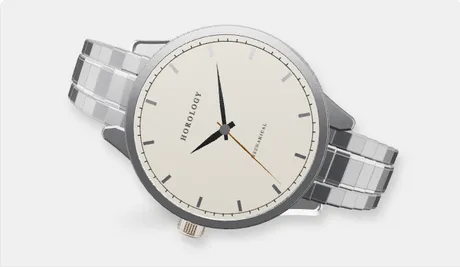
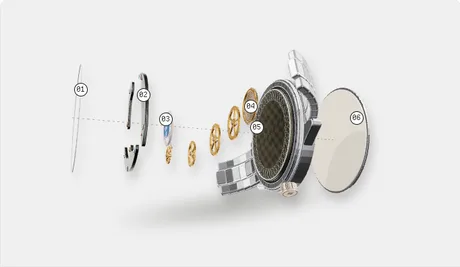
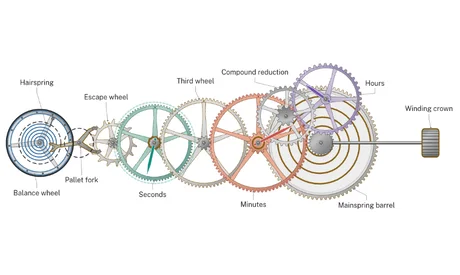
- Component inspection
- Layer isolation
- Winding and balance controls
- 10% slow motion
- Keyboard and pointer selection
- Fault and recovery scenarios
Does the mechanism behave correctly?
- Power reserve
- 75%
- Escapement releases
- Stopped
- Watch hands
- Stationary
With the balance stopped, the escapement holds the gear train. Energy remains in the mainspring, but the hands stay still.
Engineering verification
Tests covered:
- Gear ratios
- Gear direction
- Winding limits
- Escapement release timing
- Fractional timing phase
- Balance arrest and recovery
Additional validation
| Check | Result |
|---|---|
| Production build | Passed |
| Component selection | Verified |
| Camera presets | Verified |
| Exploded view and reassembly | Verified |
| Guide navigation | Verified |
| Keyboard controls | Verified |
| Responsive layouts | Checked at 320–1440 px |
| WebGL component projection | Verified |
These browser and WebGL workflows are separate from the 32 unit tests.
Runtime performance
Median: 459.1 ms
Measurement: navigation to visible canvas with a projected selection marker.
The assembled and exploded views both recorded a median animation-callback interval of 16.7 ms. This measures callback cadence, not guaranteed rendered frame rate.
Development resource usage
| Token category | Count |
|---|---|
| Ordinary input | 77,372,639 |
| Cache-read input | 74,942,091 |
| Cache-creation input | 1,769,423 |
| Output | 266,430 |
154.35M total prompt and output tokens recorded
- 29 sessions recorded: one coordinator and 28 worker sessions.
- 1,075 assistant records contained usage data.
- Cache reads are included in the cumulative prompt total.
- These are cumulative request counters, not unique input tokens.
- Unique input and monetary cost were not measured.
- The complete final scored revision does not have an audited token total.
Technical implementation
- Three.js rendering
- Displays the 3D watch and components.
- Vite production build
- Packages the application for browser use.
- JavaScript mechanism model
- Calculates gear relationships, timing, winding and balance behaviour.
The geometry and component illustrations were generated locally. The visitor-facing application does not require an AI account or inference API.
Limitations
Simplified physics
This kinematic model shows how parts move together, not all the forces that move them.
No real-watch calibration
The calculations have not been calibrated against a manufactured watch.
Limited mechanical effects
Torque and friction are simplified, so the balance stops without coasting.
Browser coverage
Chrome workflows were checked, but Safari, Firefox and physical mobile GPUs were not validated.
Experiment conditions
| Condition | Details |
|---|---|
| Starting point | Human-directed, iterative development |
| Testing | Unit tests, browser workflows and WebGL checks |
| Human involvement | Iterative direction and development |
| Autonomous one-shot test | Not performed |
This result measures one project under human-directed development. It should not be interpreted as a general success rate for GPT-6.2 Astra or as a direct comparison with other model
Final result
86 / 100The watch was not evaluated only as a 3D animation. It was evaluated on whether its visible components, interactions, calculations and mechanical explanations worked together.